Home > How to read a serial
How to read a guitar serial number
The four ways makers encode a build date in a serial, with worked examples for three, and why the honest answer is sometimes a range.
A guitar serial number is a code, and each maker writes it differently. To read yours, work out which kind of code it is, decode the digits that carry a date, and accept that some serials fit more than one year. This guide covers the four common kinds, with worked examples for the first three, then explains why a single year digit can stand for several decades and why a serial dates the build, not the sale. Serials are usually stamped or printed on the headstock, the neck plate or inside the body.
Four ways a serial can hold a date
Start by looking at the shape of the number: how many digits, and whether letters come first. That usually points to one of these schemes.
| Scheme | What you read | Example brand | Typical answer |
|---|---|---|---|
| Sequential | The whole number, looked up in a chart | Martin | A year, with the serials that belong to it |
| Day of year | Year digits plus a day count | Gibson | An exact day |
| Month and factory | Year, month and factory code in fixed positions | Epiphone | A month and year, plus a factory code |
| Prefix letters | Letters for factory or decade, then year digits | Squier | A year or a span of years, depending on the prefix |
Sequential serials: look the number up in a chart
Some makers simply number guitars in order and publish where each year ended. Martin is the clearest case. Its own page tells owners: "Use your guitar's serial number to identify its production year using the chart below." The chart's two columns are "Year" and "Last Serial Number". You find the first year whose last serial is equal to or higher than yours.
Worked example (an example number, not a real guitar): serial 81500. Martin's chart gives 80013 as the last serial of 1941 and 83107 as the last of 1942. 81500 is higher than 80013 but not higher than 83107, so it falls in 1942, whose serials run from 80014 to 83107. The chart tells you the year and the block, not the month.
There is no date hidden in the digits, so you cannot decode a sequential serial without the chart. The Martin serial number lookup compares your number with this chart.
Day-of-year serials: Gibson's eight digits
Many Gibsons made from 1977 use an eight-digit format (it ran until mid-2005) in which the first and fifth digits together give the two-digit year and the second to fourth digits give the day of the year. The last three digits are a production number for that day. This gives the year and day only. Serials from before 1977 do not follow this rule. Nine-digit serials from mid-2005 to 2013, and from mid-2019 on, use the same year and day positions but add a batch digit before the last three digits. Gibson USA serials from 2014 to mid-2019 start with 14 to 19, and those two digits are the model year, not a day-of-year code.
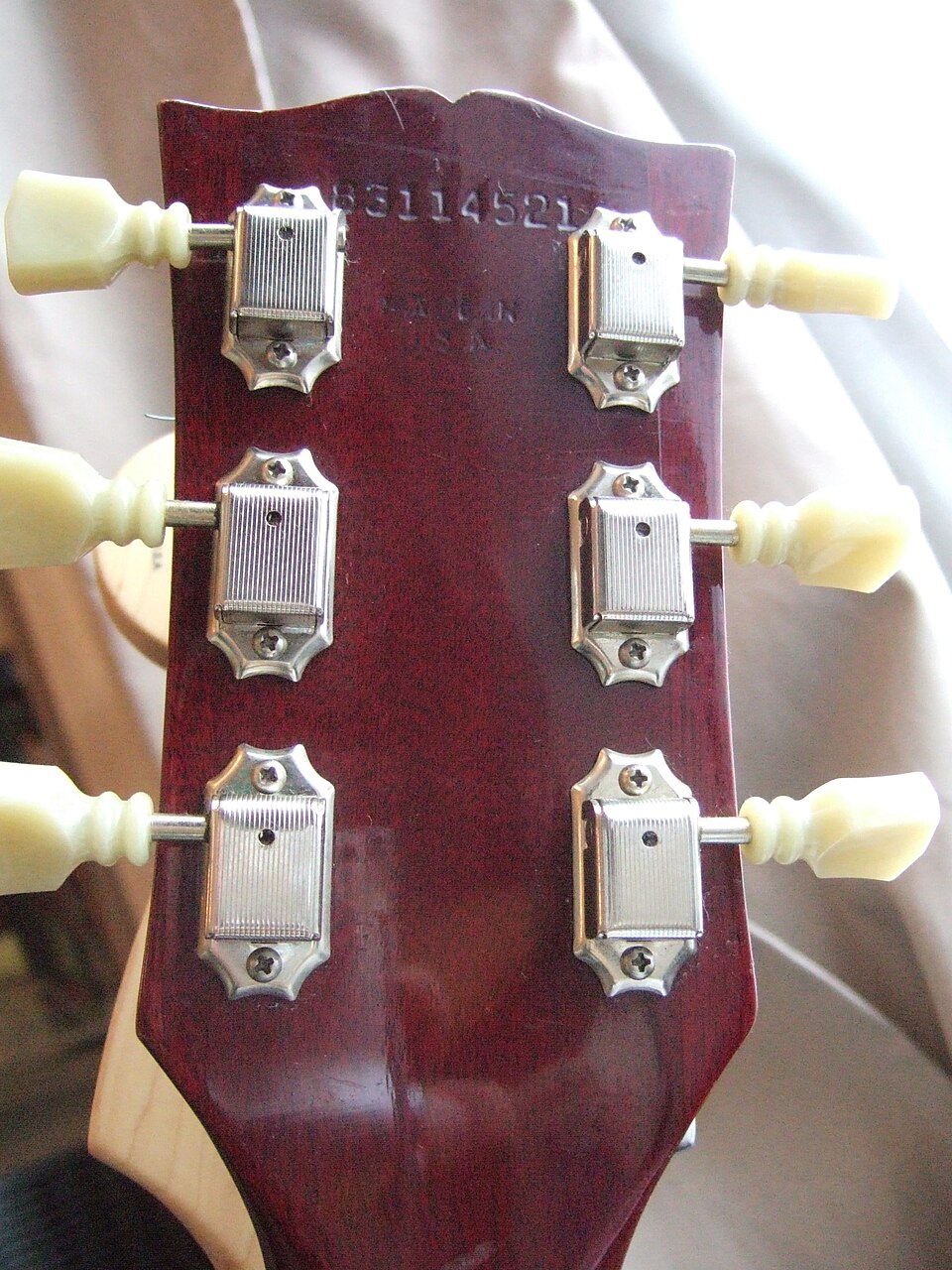
Worked example (the serial in the photo above): 83114521. The first and fifth digits, 8 and 4, give 1984. Digits two to four are 311, the 311th day of the year. 1984 is a leap year, so February counts as 29 days, and the days through October add up to 305. Day 311 is therefore November 6. The last three digits, 521, are the production number for that day. The date is November 6, 1984.
The Gibson serial number lookup covers the eight-digit format.
Month and factory serials: Epiphone's eleven digits
This reading applies only to eleven-digit Epiphone serials, which put the date in fixed positions. Per Killer Rig's factory-code guide, digits one and two are the manufacturing year, three and four the month, five and six the factory code, and the last five a sequence number. Killer Rig's page also lists what each factory code stands for. That guide and the Gibson forum thread are community compilations, not an Epiphone statement, so treat the result as a strong lead rather than a certificate.
Worked example (an example number, not a real guitar): serial 11051502060. Digits one and two, 11, mean 2011. Digits three and four, 05, mean May. Digits five and six, 15, are the factory code, and the sequence number is 2060. The result is May 2011, built at factory code 15. The Epiphone serial number decoder reads the same positions.
Seven-digit Epiphone serials work differently: the first digit gives the last digit of the production year (see the decades section).
Prefix letters: factory and decade in the first characters
Squier and several other brands begin the serial with letters. The letters usually identify the factory or country, and sometimes the decade, with year digits after them. Killer Rig's Squier guide says "CN and VN use the second letter to denote the decade" and adds: "Most of the codes use a single digit for the year, except for KC and KV."
The letters alone do not give a year, so decoding a lettered serial needs the brand-specific table. For Fender, use the table in the Fender serial number guide; for Squier, use a Squier prefix table such as Killer Rig's guide above. Then use the digits after the letters for the year.
Sources disagree on at least one prefix. Squier Wiki lists prefix E as "Made in USA", the 1980s, while Guitar Insite lists E followed by six or seven digits as a Young Chang guitar from the late 1980s to early 1990s. Treat prefix E as unresolved: check the model's known production run, or ask the maker.
Yamaha and many other makers use their own prefix or format, so these four schemes will not cover every guitar. For those brands, the maker is the authority on what a serial means.
Why one digit can mean several decades
A scheme that stores only the final year digit gives "4" for 1984, 1994, 2004 and 2014. The digit alone cannot choose. Squier's prefix letters narrow the decade for some codes, as above. Gibson's eight-digit and Epiphone's eleven-digit formats avoid the problem because the year takes two digits.
Other clues narrow it down: the style of the headstock stamp, the hardware, the model's known production run, or the era you already know from the guitar's paperwork. Only apply a clue you can support. If you cannot, keep all the candidates.
A serial gives a build date, not a sale date
The digits record when the maker stamped the instrument. Martin's chart is framed as the production year, and the Gibson example in The Music Zoo's guide reads a serial as the day an instrument was produced. Nothing in the serial records when a shop sold it or when the first owner bought it. If you are writing a listing, say "built in" the year, not "bought in" or "from" it unless you have a receipt. A guitar can sit in stock for a time before it is sold, and a date on a receipt is a different fact from a date in the serial.
Why a range is the honest answer
A range appears in two ways. A sequential chart assigns a block of serials to each year, so you learn the year and the block, never the day. A single-digit year scheme can give several possible years. Either way, a single confident date would claim more than the serial can tell you.
If you do not know which brand format you have, the guitar serial number lookup on the home page shows every format your number could fit and does not pick one for you.
What to do with the result
- Selling: quote the build year or range, name the scheme you used, and keep a photo of the serial.
- Buying: use the date as one check among several. The guitar serial number checker guide covers what a matching date does and does not prove, and how to tell if a Gibson is fake goes further for that brand.
- No match: the number may follow a format we have not sourced. Ask the maker, since only they can confirm their own records.