Home > Fender serial numbers
Fender serial number lookup: how to read your serial
Where the serial sits on a Fender, how prefixes work, a table of formats by era with sources, and why a serial alone never proves a build date.
Start with the first character of the serial. A plain number or an L is a pre-1976 neck plate and gives only a range. S, E, N or Z followed by a digit is a letter-and-digit format, and the digit after the letter is the year within the decade. MN, MZ or MX means Mexico. US followed by two digits means 2010 or later, so US11 is 2011. A leading "10" with a space, in late 2009 or 2010, is a transition case. Any of these gives a production year, not an exact build date.

Fender publishes its own lookup page. This guide could not open it, so it does not say what the page accepts or returns. Use it for a first check. For a vintage purchase, the neck date, checked by a technician, is better evidence than any serial lookup.
The tables come from dealer or retailer reference pages rather than from Fender's own material, which this guide could not open:True Vintage Guitar, Mahar's Vintage Guitars and the Vintage and Rare serial number guide. Where they differ, the box below says so.
Where to find the serial number
The location changed over the decades, so work out the era first. The locations below come from True Vintage Guitar and Mahar's.
- Neck plate. The metal plate on the back of the body where the neck bolts on. True Vintage Guitar says Fender placed the serial number on the neck plate from 1955 until 1976; Mahar's gives 1954 to mid 1976.
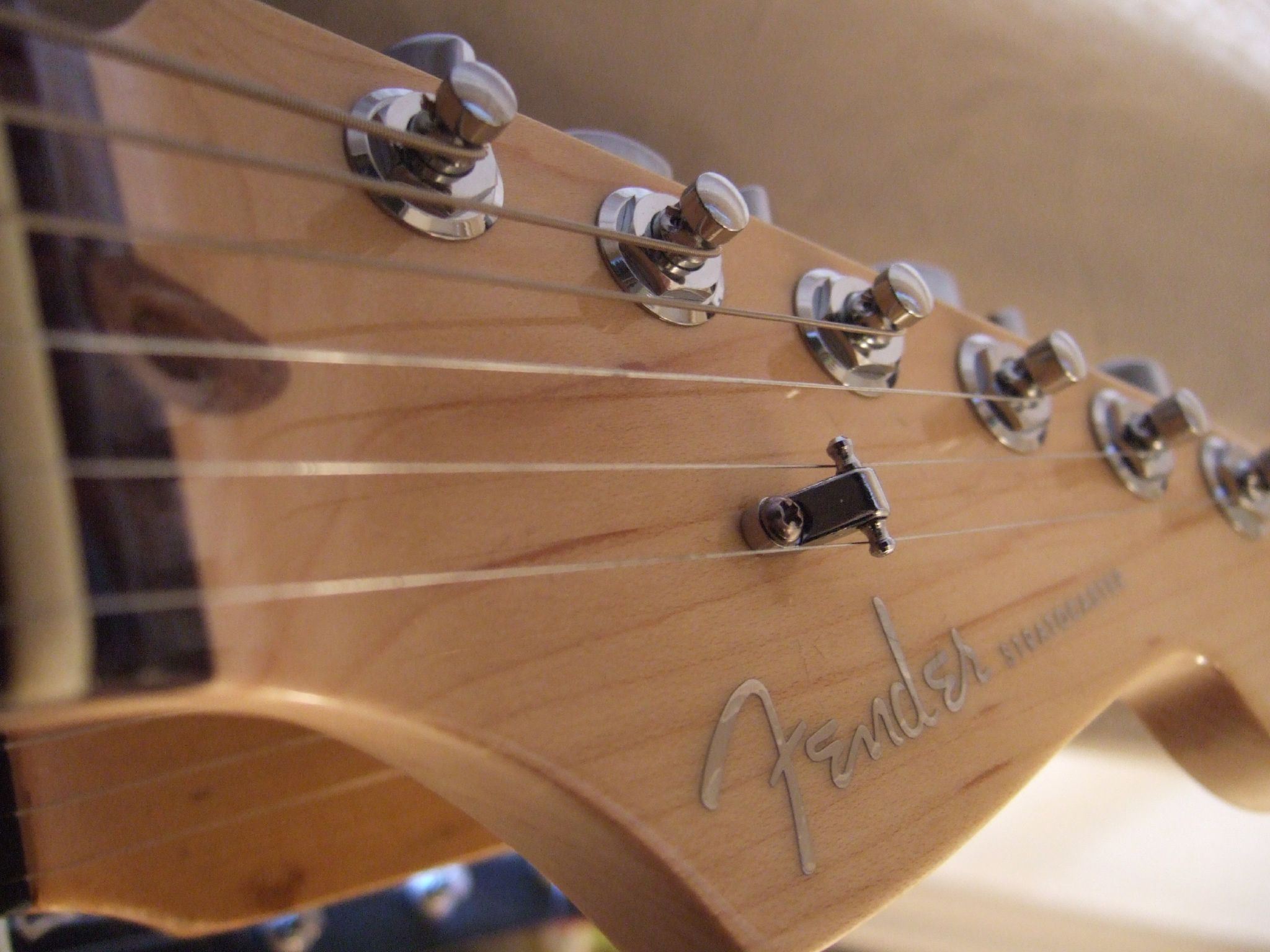
- Front of the headstock. True Vintage Guitar says guitars made between 1976 and 1995 have serial numbers on the front of the headstock.
- Back of the headstock. Mahar's lists the back of the headstock for US and Mexican instruments from the 1990s to the present. The move from front to back happened during the 1990s, and the sources disagree on exactly when (see the box below).
- Neck heel. Guitars made in Japan typically have the serial on the neck heel.
- Bridge plate. Used on many early 1950s Telecasters and Precision Basses, and on later reissues. True Vintage Guitar says "5 digit bridge plate serial numbers are not dated coded and are reissues of vintage guitars", so confirm the year from the neck date. The dealer pages give different ranges for the 1950s originals, so this page does not list them.
For a wider checklist covering other brands and body types, see where to find the serial number on a guitar.
How Fender prefixes work
From the late 1970s onward, most serials begin with letters, and the digit or digits after them give the year. True Vintage Guitar's table says, for instance, that in an "N" serial the first digit after the N is the year. A single digit repeats every ten years, so the letter tells you the decade (the table lists S, E, N and Z), and the Mexican MX format uses two year digits.
Not every prefix is a date code. True Vintage Guitar lists the V prefix as not date coded and ties it to reissue guitars. Letters can also point to where a guitar was built: the same source lists the MX prefix as Mexico (Ensenada). Squier uses its own prefixes, which this table does not cover.
Modern American serials start with US followed by eight digits. Vintage and Rare says "The first two digits of the number identify the year of manufacture, (10 for 2010, 11 for 2011, etc.)". It places the changeover in late 2009, when Fender began a serial with 10, then a space, then seven digits. Coleman's gives the same two-digit rule and says "A new serial numbering scheme was adopted toward the end of 2009 using the number “10” as a prefix".
Fender serial formats by era, with sources
The last column names the source page. The table covers selected points only, not every year: several years between the listed rows are missing, and the late 1970s and 1980s are covered only by the S and E prefix rows. For the missing years, use the full year-by-year tables on the True Vintage Guitar and Mahar's pages. Treat ranges as approximate, because the numbers overlap between years (see the sections below).
| Era and location | Serial pattern and example | How to read it | Source |
|---|---|---|---|
| 1954, neck plate | Numeric, 0001 to 8000 | Range only, not an exact date | both |
| 1959, neck plate | Numeric, 30000 to 40000 | Range only | both |
| 1963, "L" neck plate | L00001 to L20000 | Range only | both |
| Late 1965, large "F" neck plate | 100000 to 110000 | Range only | both |
| 1970 to 1975, large "F" neck plate | 280001 (1970) up to 690000 (1975) | Range only | True Vintage |
| 1976, headstock front | Bold "76" prefix | Bold 76 means 1976. It overlaps the S serials of the 1970s: a bold 76 prefix is the 1976 format, while an S serial starts with the letter S | True Vintage |
| 1970s, headstock front | S plus digits | First digit after S is the year | True Vintage |
| 1980s, headstock front | E plus digits | First digit after E is the year | True Vintage |
| 1990s, headstock (front or back) | N2123456 | Digit after N is the year (see worked example) | True Vintage |
| 2000s, headstock (front or back) | Z2123456 | Digit after Z is the year | True Vintage |
| 1990s, headstock front (Mexico) | MN plus digits, MN2 is 1992 | First digit after N is the year | True Vintage |
| 2000s, headstock front (Mexico) | MZ plus digits | First digit after Z is the year | True Vintage |
| 2010s, headstock back (Mexico) | MX12012345 | Year digits follow the X | True Vintage |
| Late 2009 to March 2010, headstock back (US) | "10", a space, then seven digits | The "10" is the year and may sit on a 2009 build. This is where Z ends and US begins | Vintage and Rare, Coleman's |
| About March 2010 onward, headstock back (US) | US plus 8 digits, e.g. US11 followed by six digits | First two digits after US are the year | Vintage and Rare, Coleman's |
| V prefix: reissue guitars | V plus digits | Not date coded. Check the neck heel for the year | True Vintage |
If the serial sits in a disputed range or has a V prefix, ask a technician or the seller for a photo of the neck heel and treat the result as the neck's date, not the build date. For checks beyond the date, see the serial number checker guide and how to read a guitar serial number.
Where the sources disagree
- The 76 headstock decal: True Vintage Guitar lists the bold 76 format under 1976; Mahar's lists the same format for 1976 to 1977.
- 1966 neck plates: True Vintage Guitar gives 110001 to 179999; Mahar's gives 110000 to 200000.
- "N2" serials: True Vintage Guitar's example reads as 1992; Mahar's lists N2 as 1992 to 1993.
- Headstock side: True Vintage Guitar says front serials run from 1976 until the mid 1990s, with back serials after that; Mahar's lists the front as mid 1976 to the 2000s and the back from the 1990s, so the two overlap.
If your serial sits in a disputed range, treat the year as uncertain.
Reading a Stratocaster serial: a worked example
The serials below are illustrative.
- Find the serial. On a 1990s or later American Strat, look at the back of the headstock (see the location list above).
- Read the letter for the decade. N2123456 starts with N, the 1990s in True Vintage Guitar's table.
- Read the digit after it for the year. The 2 gives 1992 (True Vintage Guitar).
- Check the disagreement box. Mahar's lists N2 as 1992 to 1993, so treat the year as 1992 or possibly 1993.
A modern American serial such as US11 followed by six digits is simpler: the first two digits after US are the year, so 2011 (Vintage and Rare, Coleman's).
A very early Strat may carry its number elsewhere: Mahar's says "A rare handful of the first Stratocasters have their serial number on the plastic tremolo cover plate". If you are comparing a used Strat with an advert, the serial number checker guide for buyers lists what else to verify.
When a serial is not proof of the build date
The caveat applies mainly to neck-plate guitars made before 1976. Mahar's puts it directly: "Neck plates were stored in bins and were definitely NOT doled out in sequential order!" It adds that "Necks and bodies were frequently made and assembled at different times." True Vintage Guitar calls its early bridge-plate ranges approximate because Fender never intended the serial numbers to be sequential. For those guitars the serial gives a range, and Mahar's says neck dates and component codes are often more accurate than the serial number itself.
A neck date is a production date Fender marked on the neck. Vintage and Rare says "Fender tagged a production date at the butt of the detachable neck of their guitars", hand-written on early necks and ink-stamped on later ones. Reaching it means removing the neck, which is a job for a technician, not something to try on a guitar you do not own. A neck date narrows the range but dates the neck, not the finished guitar. If it disagrees with the serial, or the neck may have been replaced, the serial does not settle the question.
If you do not know which brand format you have, the Guitar Serial Number Lookup home page lists the brands covered on this site.